Find easy-to-understand Would You Rather questions made for kids. Pick a choice, see what others choose, and keep playing. Browse the questions or use the filters to find one you want to try.
Browse below or filter by section. Click Option A or Option B on any card to vote and see live results!
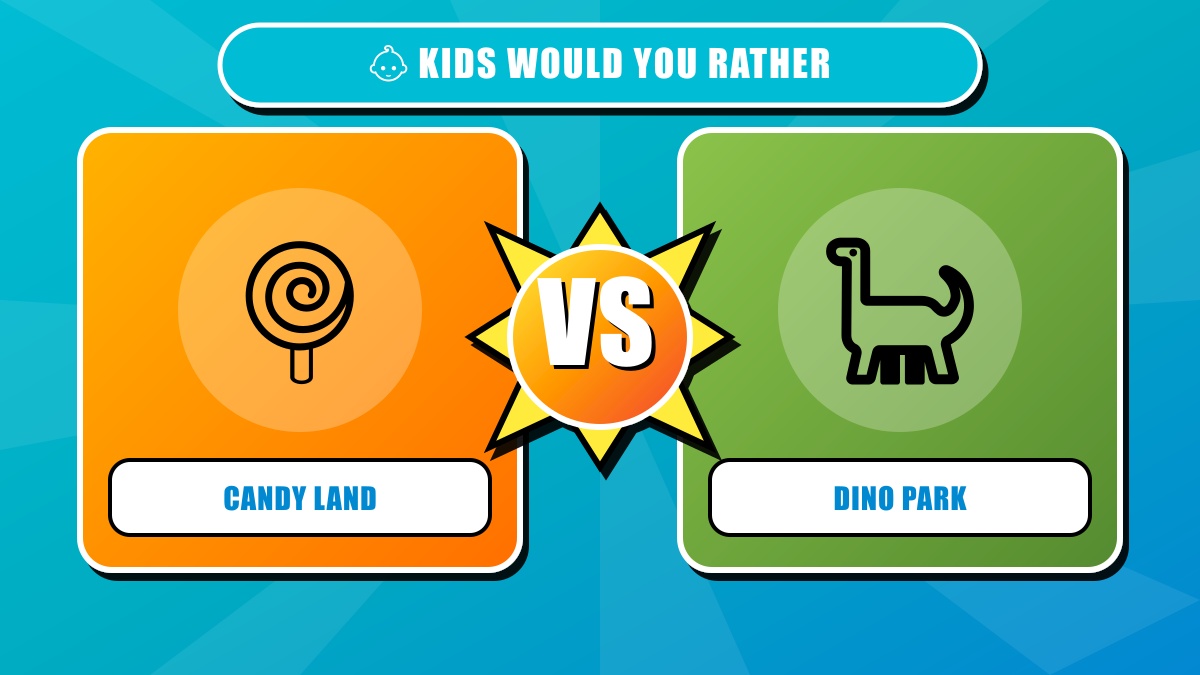
These Kids edition Would You Rather questions are written with simple choices that are easy to understand and enjoyable to answer. The collection covers imaginative situations, animals, school, food, adventures, superpowers, and other topics that can get kids thinking about which option they would choose.
Some questions have an easy answer, while others make you stop and consider both choices. There is no right or wrong answer. The goal is simply to choose an option, share your answer, and enjoy seeing what someone else would pick.
You can browse all the questions or use the available filters to find a particular type of question. Pick one that sounds interesting, read both choices, and see which side you would choose.
A good Would You Rather question gives you two choices that are interesting enough to make you think. You might have to choose between two animals, imagine having a special ability, or decide which unusual situation you would rather experience.
The answers can be just as interesting as the questions. One child might make a choice immediately, while another might have a completely different idea. Asking “Why would you choose that?” can turn a simple answer into a fun conversation.
The imaginative choices also give kids plenty of room to come up with their own ideas. Questions about magical abilities, unusual adventures, animals, or impossible situations can lead to creative answers that are often completely different from what you expected.
Playing Would You Rather is simple. Read the two choices out loud, let the child decide which one they would rather choose, and then talk about the answer. There is no right or wrong choice — the fun is in seeing what they pick and why.
Read the question and both options clearly so the child understands what each choice means. If a question has an unfamiliar word or idea, explain it before asking them to choose.
Give them a moment to decide which option they would rather have, do, or experience. Some questions will have an obvious answer, while others may take a little more thought.
After they choose, ask what made them pick that option. Their explanation can sometimes be more interesting than the answer itself and may lead to a completely different question or story.
If several children are playing, let everyone answer the same question before comparing their choices. It can be interesting to see who picked the same option and who went in a completely different direction.
Once everyone has answered, move on to another question. You can stay with the same type of question or switch to another category whenever you want something different.
A few simple things can make the game easier and more enjoyable:
There are plenty of choices waiting for you. Pick a question, make your choice, and when you're ready for more, play the Would You Rather Game and keep the questions going.
Yes, 100%! All questions in the kids category are family-friendly, positive, and easy to understand for preschool, kindergarten, and elementary school children.
Yes, the questions can be kept simple and suitable for younger children by using familiar topics and avoiding complicated or mature situations. Adults can choose questions that match the children's ages and comfort levels.
Yes, kindergarten children can enjoy Would You Rather when the questions use short sentences, familiar words, and easy choices. Simple questions about favorite foods, animals, colors, toys, and imaginary adventures are easier for young children to understand.
Teachers and parents can use them as conversation starters, classroom icebreakers, party activities, or quick group games. Asking children to explain why they made a particular choice can also encourage them to practice expressing their ideas.
It encourages critical thinking, decision-making, language development, and self-expression as children learn to explain the reasoning behind their choices.